

Global Trade

March 31, 2026
Middle East smelter attacks trigger global aluminum supply concerns
Written by Laura Miller
The aluminum industry is bracing for significant supply-chain repercussions after Iranian strikes hit two major smelters in the Middle East – Emirates Global Aluminium’s (EGA) Al Taweelah complex in the United Arab Emirates (UAE) and Aluminium Bahrain (Alba) – on March 28.
Together, the facilities represent roughly 4% of global aluminum and alumina capacity, according to Timna Tanners, managing director of equity research at Wells Fargo. Tanners said the attacks “rattle ali,” noting EGA’s “~1.6 MT/yr smelting, ~2.4 Mt/yr alumina” capacity and Alba’s “1.6 Mt/yr smelting.”
The Aluminum Association said it is “increasingly concerned about the safety of aluminum workers and broader market impacts.” The group emphasized the Gulf Cooperation Council’s (GCC’s) central role in global supply chains. GCC countries supply about 9% of global unwrought aluminum and accounted for roughly 21% of US unwrought imports in 2025 – near record levels. The Aluminum Association also noted 500,000-600,000 tons of curtailments were already announced before the attacks, driven largely by energy constraints.
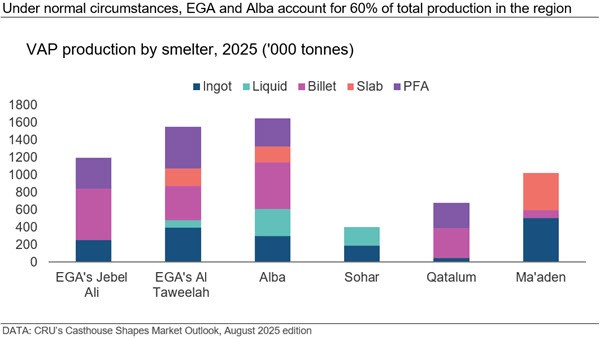
The following image from CRU analysts provides a better idea of what production is potentially affected by the attacks.
Aluminum Association President and CEO Charles Johnson called the strikes “troubling,” adding, “We’re relieved to hear there were no fatalities. … Aluminum firms are working around the clock to mitigate impacts and adjust operations and supply routes as needed.”
Logistics disruptions deepen
The closure of the Straight of Hormuz to Western shipping is compounding the challenge, making it difficult both to export metal and import key inputs such as alumina. Trade flows are already shifting, and industry groups warn that prolonged instability could create shortages in specific aluminum products.
Trade attorney Lewis Leibowitz said that the damage at the UAE and Bahrain facilities “is likely to take several months or maybe even longer to repair” and that repairs may not begin until sites are deemed safe from further attack. He warned the disruption will be felt most acutely in Western markets: “A serious disruption to global aluminum trade will exist for a while, causing prices to spike and likely stay high until there is a cease fire in the Iran war.”
Structural tightness meets geopolitical shock
Even before the conflict, global aluminum supply was tightening. Joe Quinn of the SAFE Foundation said the market is now defined by “structural constraints rather than cyclical oversupply,” with China nearing its self-imposed production ceiling and supply from Europe, Africa, and the Middle East increasingly unreliable.
Quinn estimated disruptions across Qatar, Bahrain, and the UAE “could remove up to 800,000 tons of aluminum production in the short term,” a figure that exceeds total US primary output in 2025. If supply from traditional partners falters, he warned, replacement metal will likely come from “geopolitical competitors, particularly Russia and China.”
North American producers respond
Canada, the largest supplier of aluminum to the US, is already at full capacity. Jean Simard of the Aluminum Association of Canada said the region is shifting rapidly from a price shock to a supply shock, with potential for a demand shock to follow. “Scarcity brings up prices, which impacts demand,” he said, adding that scrap prices will also rise as buyers seek alternatives.
Simard called aluminum “a strategic part of North America’s economic and national security” and urged a tariff carve-out for Canada to ensure supply stays within the region.
In the US, the attacks have intensified debate over Section 232 tariffs. Tanners noted that Century Aluminum told investors the White House assured it of “no exceptions, no exclusions” to the 50% tariff rate – an outcome she said strengthens the domestic aluminum and steel bull case amid Middle East supply risk.
Market watching for duration, not headlines
The American Metals Supply Chain Institute (AMSCI) said it is too early to assess the full impact but noted markets tend to react more strongly to sustained disruptions than isolated incidents. “Any disruption involving major Gulf products could raise concerns around supply continuity, depending on the extent and duration of any operational impact,” the group said.
With damage assessments ongoing, shipping routes constrained, and no clear timeline for repairs, the global aluminum market is entering a period of heightened uncertainty. As the Aluminum Association put it, the industry is once again being tested by “regional and global challenges” with no immediate resolution in sight.