Building & Construction
April 1, 2026
Kibar Americas acquires idled Novelis Fairmont aluminum sheet and foil plant
Written by Nicholas Bell
Kibar Americas has acquired the former Novelis flat-rolled aluminum facility in Fairmont, W. Va., roughly nine months after production ceased at the site.
The transaction follows a sequence that began in March 2025, when Novelis said it would permanently shut down the Fairmont plant effective June 30, 2025.
The company briefly pursued a sale through a non-binding letter of intent in April 2025, then reverted to closure when that effort did not result in a deal. Production ended in the first quarter of its fiscal 2026.
Kibar Americas, the US subsidiary of Turkey-based Assan Alüminyum, announced the acquisition March 31. The company said it will evaluate options for the site’s future use.
Fairmont operations
Operating permits show the Fairmont facility functioned as a cold rolling mill focused on downstream processing.
The site included two rolling mills and a series of annealing furnaces, along with supporting systems tied to lubricant recovery and gas generation. According to the site’s operating permit issued in 2023, initially set to expire in 2027, the rolling mills dated to 1960 and 1967, with later modifications on the latter mill made in 1999.
That said, a 1992 EPA information request response from the plant, then operated as Alcan Rolled Products, listed annual rolled aluminum production at about 54,000-81,6000 metric tons per year, while noting actual annual output depended on product mix, alloy, temper and gauge.
Equipment listed in that filing included two rolling mills corresponding with the 1960 and 1967 years, respectively, with a maximum annual production capacities of a little more than 100,000 metric tons per year and about 72,500 metric tons per year, alongside multiple annealing furnaces and slitters. The same filing showed average annual production levels materially below those figures, in both cases below half of stated maximum capacity, based on continuous 24-hour, 365-day operating assumption.
In its last full year of operation, CRU Group estimates the plant’s output at roughly the mid-30,000 metric tons per year range of foil stock. (CRU Group is the parent company of AMU.)
Individual annealing lines were listed with maximum annual throughputs ranging from 16,500-33,000 tons per year, depending on the furnace. Across the five furnaces listed in that filing, maximum annealing throughput summed to roughly 126,500 tons per year, while reported average production across those same units totaled closer to 59,000 tons per year, pointing to utilization rates well below full capacity even at that time.
Although the filing dates to 1992, the core equipment base remains largely consistent with what appears in the most recent 2023 operating permit. The furnaces listed in that filing align closely with those permitted in 2023, with later changes including a 1999 modification to the 1967 rolling mill, modifications to two annealing furnaces from the 1970s, and what appears to be the replacement of a 1950’s annealing furnace with a new unit installed in 1994.
Product scope and end markets
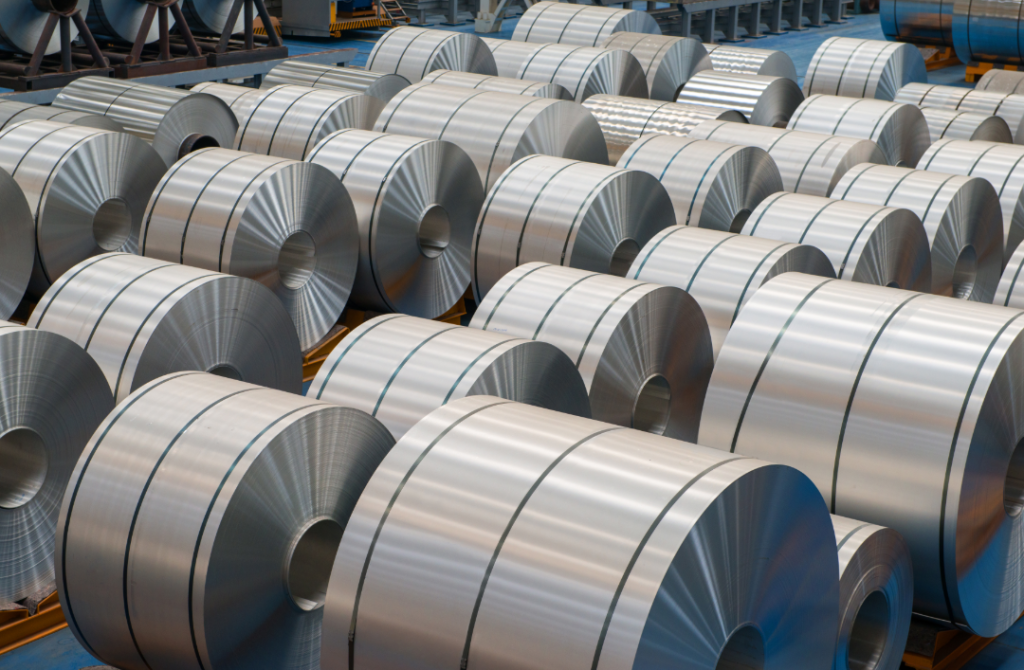
Novelis described the Fairmont plant as producing aluminum sheet and light-gauge foil for specialty applications. The absence of hot rolling equipment and the presence of multiple annealing furnaces align with a downstream finishing role, where coil is received, cold reduced, annealed, and slit of finished for end use.
Kibar Americas’ existing product mix provides a clearer view of how the site could be repositioned. The subsidiary’s product portfolio spans flat-rolled aluminum products across several alloy groups and end markets. In automotive applications, this includes heat shields and heat exchanger materials based on 1XXX, 3XXX and 8XXX series alloys.
HVAC products rely on similar series for heat transfer components, while packaging applications include container foil, lidding foil and flexibly packaging, typically produced from 3XXX and 8XXX alloys.
Industrial and building products extend into insulation, cable foil and painted sheet, drawing on 1XXX, 3XXX, and 5XXX series inputs.
This range overlaps with the Fairmont plant’s historical capabilities in foil and light-gauge sheet, particularly in packaging, insulation, and specialty industrial uses.
Closure to redevelopment
The Fairmont closure occurred alongside Novelis’ decision to shut its Richmond, Va., facility, which included pellet casting, hot rolling, and recycling tied to building and construction sheet. That move reduced the company’s US footprint in certain non-core segments while it focused on automotive and can sheet investments elsewhere.
The site remained a downstream operation without integrated melt or hot rolling. That limited its role within Novelis’ broader system but may make it more adaptable for a different product mix under new ownership.
Kibar Americas operates as the US arm of Assan Alüminyum, which has installed annual flat-rolled capacity of up to more than 350,000 metric tons per year across its Turkish operations.
Assan is one of Europe’s largest aluminum foil producers and has positioned itself across foil, coated products, and specialty flat-rolled segments.
For Kibar Americas, the acquisition provides an entry point into US-based flat-rolled production without building a greenfield operation.
For the aluminum market, the site represents potential incremental capacity in foil and specialty sheet, depending on how it is redeveloped and what alloy and end market/s it ultimately serves.