Aluminum Scrap Markets

September 24, 2026
AMU Survey: Aluminum scrap outlook turns toward oversupply
Written by Nicholas Bell
The aluminum scrap outlook changed sharply from August as recycler forward expectations swung toward oversupply. Inventory drawdowns became much less common, obsolete scrap availability increased and export demand lost its improving responses. Current demand also became less positive, although Midwest premium and UBC expectations remained concentrated around stable or higher prices.
Current recycler demand gives back part of August’s rebound
Recycler demand became less positive in September.
Half reported stable demand. The remaining responses split evenly between improving and declining conditions.
In August, 40% reported improvement and 60% stability. No recycler reported decline.
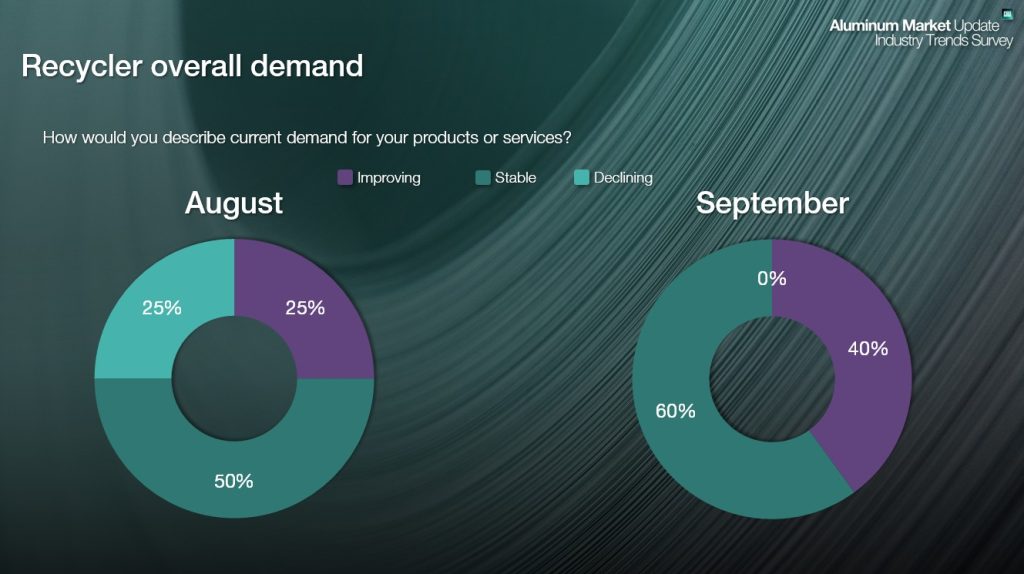
September reverses part of the demand rebound that separated August from July. It does not return the group to July’s distribution, when 40% reported declining demand.
Qualitative recycler lead times remained unchanged. Every recycler reported stable lead times for the second consecutive month.
Inventory drawdowns retreat sharply
Recycler inventory management changed more than current demand.
Only 25% reported drawing inventories down in September, compared with 67% in August and 70% in July. The remaining 75% kept inventories steady.
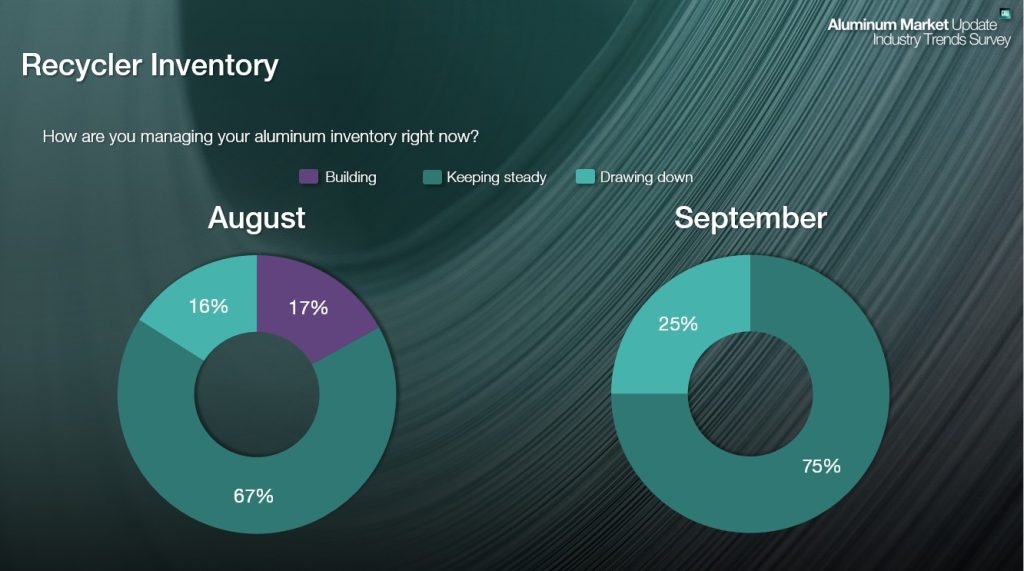
That removes one of the strongest physical-market features of the prior two surveys.
The earlier drawdowns could have results from several different conditions. Companies can deliberately reduce stocks when business is weak, while stronger demand can also consume inventory faster than replenishment.
September responses give less support to either form of widespread drawdown because most recyclers were simply holding inventories steady. Yet, when read beside obsolete scrap availability responses, the picture becomes more nuanced.
Scrap supply expectations normalize for obsolete material
About 75% of recyclers said enough obsolete scrap was available to meet demand, up from 60% in August. The remaining 25% reported insufficient availability.
The full response pool was even more comfortable. About 89% reported sufficient obsolete scrap, up from 77% in August.
Obsolete scrap availability returned toward its recent range in September, after August produced the least comfortable result of the prior several months. As a result, September’s result looks more like a return toward recent conditions than a new increase in scrap availability. August stands out more clearly as the recent low point.
The September result coincided with a sharp change in recycler inventory management. Those conditions are compatible with replenishment catching up with material moving out. One plausible interpretation for August is recyclers were using existing inventory faster than they were replenishing it.
Export demand shifts lower after August increase
Recycler export demand also moved lower.
No recycler reported improving export demand in September. Two-thirds reported stability, while one-third reported decline.
In August, 40% reported improving export demand and 60% reported stability. No recycler selected decline.
The overall survey moved in the same direction. Improving responses fell to zero from 14%, while declining responses increased to 29% from 7%.
End-market results also became less positive. Two-thirds of building and construction-linked respondents reported declining export demand compared with 20% in August.
Recycler outlook swings toward oversupply
The three-month balance produced the largest change in the aluminum scrap outlook.
Three quarters of recyclers expected an oversupplied market in September. Nonetheless, the remaining quarter expected undersupply, while none expected balance.
August produced the a fundamentally different distribution. Half expected balance and half expected undersupply, with no oversupplied responses. July was more dispersed, with 40% balanced and 30% in each directional category.
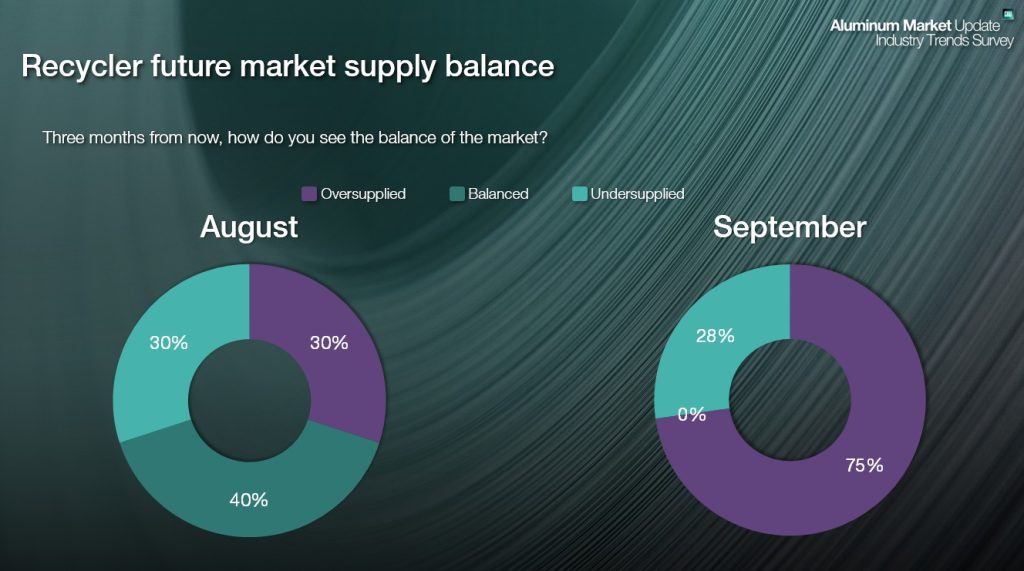
The contrast with non-recyclers is notable. About 57% of non-recyclers expected balance, while 29% expected undersupply and 14% expected oversupply.
Price expectations diverge from forward balance
Midwest premium expectations did not move lower with the recycler outlook.
About 75% of recyclers expected a stable Midwest premium, while 25% expected it to increase. The distribution was little changed from August’s response split.
UBC expectations became even more concentrated around stability. About 75% expected stable UBC prices and 25% expected higher prices.
In August, half expected stability, one-third higher prices, and 17% lower prices.
The lower category disappeared in September even as recycler demand became less positive and three-month expectations moved sharply toward oversupply.
A genuine point of tension in the September results emerged: Forward physical market responses became looser, but recycler price expectations did not move lower with them.
The two questions also measure different things. The Midwest premium applies across the broader aluminum market, while UBC pricing can reflect benchmark movements as well as the buyer spread for scrap.
Putting it together
The aluminum scrap outlook shifted substantially from August. Recycler export demand weakened, inventory drawdowns receded and obsolete scrap availability returned toward its recent range.
The current market was less one-sided. Half of recyclers still reported stable demand, while the other half split between improvement and decline. Lead times also remained unanimously stable.
Price expectations provide the main conflicting signal. Recyclers did not move toward lower Midwest premium or UBC expectations despite a much more oversupplied forward balance.
September reads less like an immediate surplus than a recycler group seeing less pressure on inventories while expecting the supply-demand balance to loosen further ahead.